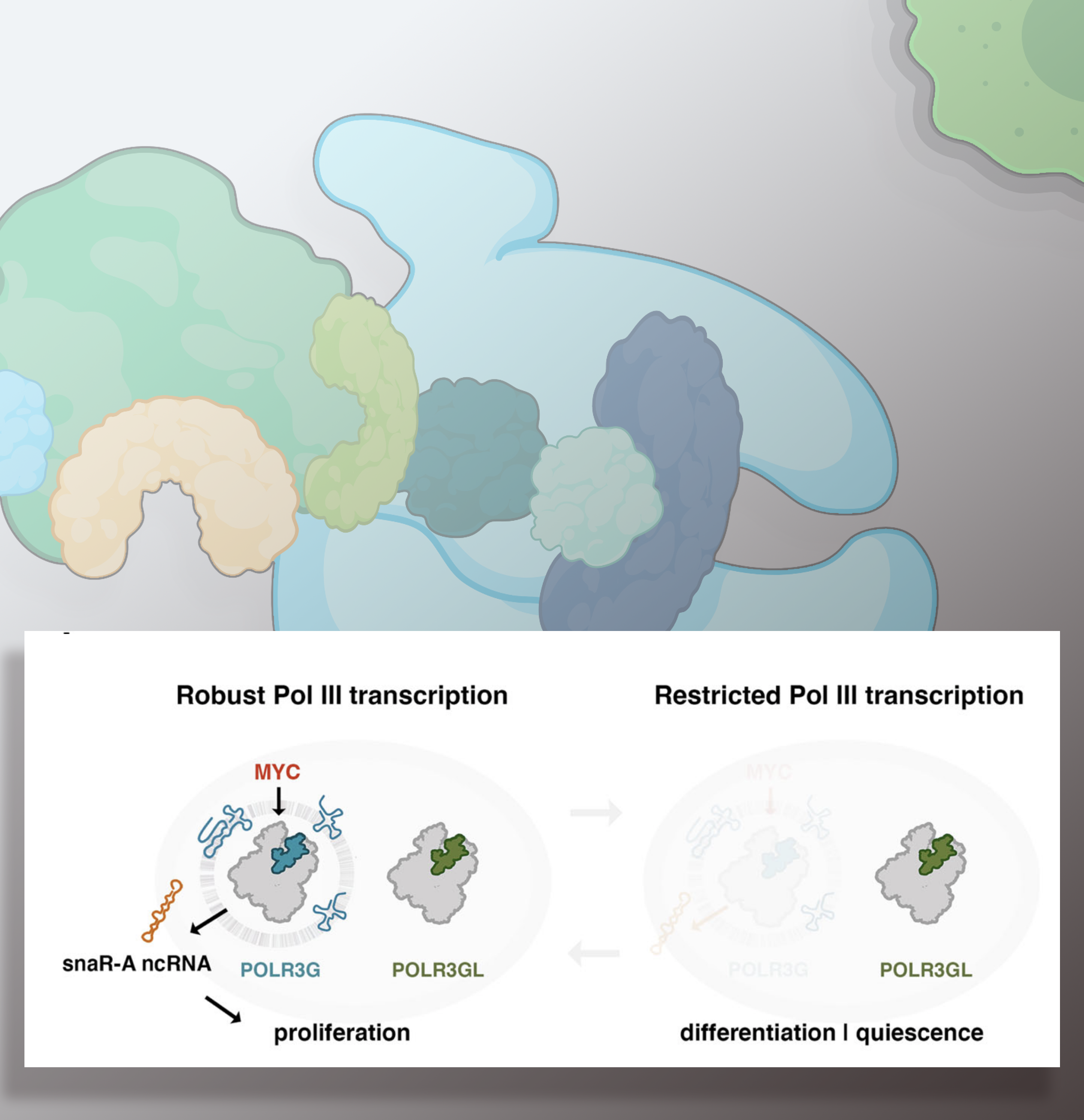
Upregulation of POLR3G, which is driven by MYC, identifies a subgroup of patients with unfavorable survival outcomes in specific cancers,
further implicating the POLR3G-enhanced transcription repertoire as a potential disease factor.
Read a summary of this paper below or the full article in the Springer Nature Journal here:
https://trebuchet.public.springernature.app/get_content/458d2b7b-51ee-4868-a000-cd8a2188f84e
https://doi.org/10.1038/s41467-022-30323-6
Figure h:

Kevin Van Bortle 1,2,3 , David P. Marciano 1 , Qing Liu1,4,5 , Tristan Chou1 , Andrew M. Lipchik 1,6,
Sanjay Gollapudi7, Benjamin S. Geller 1,8 , Emma Monte 1 , Rohinton T. Kamakaka 8 & Michael P. Snyder 1
RNA polymerase III (Pol III) includes two alternate isoforms, defined by mutually exclusive incorporation of subunit POLR3G (RPC7α) or POLR3GL (RPC7β), in mammals. The contributions of POLR3G and POLR3GL to transcription potential has remained poorly defined.
Here, we discover that loss of subunit POLR3G is accompanied by a restricted repertoire of genes transcribed by Pol III. Particularly sensitive is snaR-A, a small noncoding RNA implicated in cancer proliferation and metastasis. Analysis of Pol III isoform biases and downstream chromatin features identifies loss of POLR3G and snaR-A during differentiation, and conversely, re-establishment of POLR3G gene expression and SNAR-A gene features in cancer contexts.
Our results support a model in which Pol III identity functions as an important transcriptional regulatory mechanism. Upregulation of POLR3G, which is driven by MYC, identifies a subgroup of patients with unfavorable survival outcomes in specific cancers, further implicating the POLR3G-enhanced transcription repertoire as a potential disease factor.
https://doi.org/10.1038/s41467-022-30323-6
1 Department of Genetics, Stanford University, Stanford, CA 94305, USA.
2 Department of Cell & Developmental Biology, University of Illinois Urbana-
Champaign, Urbana, IL 61801, USA.
3 Cancer Center at Illinois, University of Illinois Urbana-Champaign, Urbana, IL 61801, USA.
4 Stanford Cardiovascular Institute, Stanford University School of Medicine, Stanford, CA 94305, USA.
5 Department of Physiology, Southern Illinois University School of Medicine,
Carbondale, IL 62901, USA. 6 Department of Pharmaceutical Sciences, Eugene Applebaum College of Pharmacy and Health Sciences, Wayne State
University, Detroit, MI 48201, USA.
7 Genomics Research Internship Program at Stanford, Stanford University, Stanford, CA 94305, USA.
8 Department of Molecular, Cell, and Developmental Biology, University of Santa Cruz, Santa Cruz, CA 95064, USA.
NATURE COMMUNICATIONS | (2022)13:3007 | https://doi.org/10.1038/s41467-022-30323-6 | www.nature.com/naturecommunications 1
1234567890():,;